Saturday, September 8, 2007

Horse Racing

Horse racing starts again tomorrow and it is the most favorite past time for people living in Hong Kong.

Horse racing in Hong Kong commenced in 1841 with the arrival of the British, who immediately set about draining a malarial swamp to form a racetrack at Happy Valley. With the exception of a few years during World War II, the track has been non-stop action ever since. The Hong Kong Jockey Club was founded in 1884 and changed from an amateur to a professional organisation in 1971. A second racecourse was opened at Sha Tin in 1978.

The growth of the sport's popularity was attended by an increase in illegal bookmaking. In 1973, the Government authorised the Club to operate off-course betting branches to tackle illegal gambling head-on. Since then, the Mark Six lottery and regulated football betting have also been introduced to combat illegal gambling.

The Club has a long tradition of donating to charitable causes, but it was in the 1950s, as Hong Kong struggled to cope with post-war reconstruction and a massive influx of immigrants, that this role became integral to its operation. In 1955 the Club formally decided to devote its surplus each year to charity and community projects.


During the race season, many race fans in Hong Kong can be seen burying their heads in newspapers at teahouses studying the odds for their favorable horses.

Horse racing days are held in two racecourses at Happy Valley and Sha Tin on most Wednesdays and weekends from September to June, attracting about 1.2 million race goers each racing day, according to the Jockey Club's statistics.

The club's betting turnover has already exceeded 16.3 billion HK dollars (2.1 billion U.S. dollars) every fiscal year, contributing 1.3 percent to Hong Kong's gross domestic product and10 percent of the special administrative region government's tax revenue.

As one of Hong Kong's top 10 employers, the Jockey Club currently employs more than 5,000 full-time workers and 20,000 part-time staff on race days.

A major entertainer for Hong Kong people, the Jockey club also serves as the city's largest charity organization with its charity donation exceeding 10 billion HK dollars (1.3 billion U.S. dollars) during the past years.

On placing bets, there are several types:

Single-Race Bets

Pool Name - Dividend Qualification

  • Win (獨贏) - 1st in a race.
  • Place (位置) - 1st, 2nd or 3rd in a race with 7 or more declared starters or 1st, 2nd in a race with 4, 5, 6 declared starters.
  • Quinella (連贏) - 1st and 2nd in either order in the race.
  • Quinella Place (位置Q) - Any two of the first three placed horses in any finishing order in the race.
  • Trio (單T) - 1st, 2nd and 3rd in any order in the race.
  • Tierce (三重彩) - 1st, 2nd and 3rd in correct order in the race.
  • First Four (四連環) - 1st, 2nd, 3rd and 4th in any order in the race.

As of September 2006, all Win, Place, Quinella, and Quinella Place bets (including All Up bets) of a value of at least 10,000 Hong Kong Dollars are eligible for a 10% rebate if the bet or betline loses.

Multiple-Race Bets

Pool Name - Dividend Qualification - Consolation [if any]

  • Double (孖寶) - 1st in two nominated races - 1st in 1st leg and 2nd in 2nd leg.
  • Treble (三寶) - 1st in three nominated races - 1st in first two legs and 2nd in third leg. Now discontinued in favor of the First Four bet type.
  • Double Trio (孖T) - 1st, 2nd and 3rd in any order in both legs.
  • Triple Trio (三T) - 1st, 2nd and 3rd in any order in three legs - 1st, 2nd and 3rd in any order in any two Triple Trio legs.
  • Six Up (六環彩) - 1st or 2nd in each of the legs nominated to comprise the Six Up - 1st or 2nd in each of the legs nominated to comprise the Six Up.

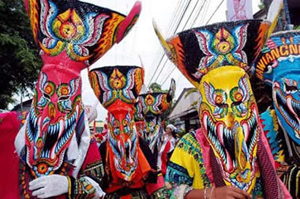
Chinese Ghost Festival


Just as the West has Halloween for ghost and souls, the Chinese have a holiday to fete the departed spirits of the underworld. The Hungry Ghost Festival falls on the 14th night of the seventh lunar month. It is a popular occasion celebrated throughout China on that very night and the day that follows.

Hotel reservations in Hong Kong

The Origin of Hungry Ghost Festival
The Hungry Ghost Festival has its roots in the Buddhist festival Ullambana, and also in Daoist culture. In the Tang Dynasty, the Buddhist festival Ullambana and its traditional festivities were mixed and celebrated on one day. Thus, the Ghost Festival has a special meaning for all Buddhists.


The Chinese believe that the dead become ghosts who roam between Heaven and Earth on the day of their death. Spirits without descendants to make offerings to them are fed during the ghost festival, so that they may not cause trouble to the living. This custom, an extension of the traditional Chinese notion of 'universal love', was started after the legend "Mulien Saving his Mother from Hades", giving Ghost festival a dimension of filial piety.


Customs of the Hungry Ghost Festival
Traditionally, ancestor worship was an important part of the festivals. with activities including preparing ritualistic offerings of food, and burning ghost money and bags containing cloth to please the visiting ghosts and spirits of one's ancestors, as well as other deities. Other activities include, burying and releasing miniature paper boats and lanterns in rivers, which signifies "giving directions to the lost ghosts and spirits of the ancestors and other deities." A very solemn festival of ancestor worship, it nevertheless represents a connection between ancestors and their descendants, the living and the dead, earth and heaven, as well as body and soul.


Taboos in the Ghost Month
In Chinese tradition, the seventh month in the Chinese calendar is called the Ghost Month, in which ghosts and spirits, including those of deceased ancestors, come out from the underground world to visit earth. The Hungry Ghost Festival is the climax of a series of the Ghost Month celebrations. It is said that the ghosts would wander on the streets at night, so people are advised not to go out at night. There are also many other taboos: moving a house, opening a business, and holding a wedding ceremony should all be avoided, swimming and other water sports are also shunned. If a child is born on this day, their birth date would usually be changed when registered or celebrated to remove any doubt that they might be in contact with a ghost. If someone dies on this day it would upset the family, as it is believed that the deceased would leave with the ghosts.

Although the romantic festival of Chinese Valentine's Day falls in the same month, the ghosts still make a strong impression on people's minds. It is said that you will meet the ghosts when you go out during the night, and if you don't believe it, someone will tell you that they have seen ghosts with their own eyes. To some, the lunar seventh month is more scary than romantic.

(Source: 51766.com / Translated by Women of China)

Thursday, September 6, 2007

Chinese and the number 8

8 The number "8" is the favorite number for Chinese as it is pronounced as "Fai"發. 發 means rich in Chinese and a lot of people would like to be rich.

That's why you will see that:

  • they prefer to live on the 8th floor
  • they use the phone number with a lot of number 8
  • the license template will have the number 8

Google Search (on the Web and Hong Kong Cinemas)